



Finding faint asteroids hidden in James Webb Space Telescope images takes innovative thinking and powerful computing. At Western University, GPU-accelerated research is helping bring these objects into view. AI-generated illustration.
Astronomical observatories generate enormous volumes of data, but some of the most interesting discoveries may be hiding in observations collected for entirely different purposes.
At Western University's Institute for Earth & Space Exploration, doctoral researcher Anthony Corrado Girmenia, working under the supervision of Dr. Stanimir Metchev, is developing computational techniques to identify small asteroids in archival images from the James Webb Space Telescope (JWST).
His research combines astronomical image processing, custom Python software and GPU-accelerated computation to detect objects that conventional image-processing methods can overlook.
The computational challenge is substantial. Identifying a faint moving asteroid may require processing the same astronomical observations against hundreds of thousands — or even millions — of possible trajectories.
Supporting that work is a custom-built Quoted Tech workstation affectionately nicknamed Tomato. And the approach is already producing results: an initial survey of JWST observations has identified eight previously undiscovered asteroids.
The Challenge: Finding a Needle in a Cosmic Haystack
Girmenia's research focuses on near-Earth asteroids, particularly objects approximately 10–20 metres in diameter. These small bodies generally originate in the asteroid belt between Mars and Jupiter. Gravitational interactions can occasionally redirect them into orbits that bring them closer to Earth.
Understanding their population is important for assessing potential impact hazards, but existing observations present a significant scientific discrepancy.
Estimates derived from meteor-monitoring observatories suggest that objects of this size may enter Earth's atmosphere approximately every two to three years. Estimates based on previous telescope surveys, however, suggest an interval closer to 20–30 years.
That difference raises an important question: are telescope surveys underestimating the population of small asteroids, or is another factor responsible for the discrepancy? Resolving it requires identifying more objects and improving our understanding of their abundance.
Why small asteroids are so hard to detect
Their apparent brightness depends on their size, distance and the radiation they reflect or emit. At astronomical distances, a 10–20 metre object may produce an extremely faint signal against the background of stars and galaxies.
Their movement introduces an additional complication. Traditional astronomical image stacking combines multiple exposures to improve the signal-to-noise ratio of faint, relatively stationary objects. Moving asteroids, however, change position between exposures and can appear as blurred streaks in the resulting images.
Detecting them requires a different computational approach.
A New Approach to Existing Telescope Data
Girmenia's research takes advantage of the extensive public archive of images collected by JWST. Although these observations were primarily acquired for other astronomical investigations, they can also contain previously unidentified solar system objects moving through the foreground.
Rather than relying on the final stacked images, Girmenia developed a custom processing procedure that recovers the individual exposures used to create them. He then applies a technique known as shift-and-stack.

Tracking motion across the night sky: successive telescope images reveal an asteroid moving against the background stars. Video courtesy of Anthony Corrado Girmenia.
How shift-and-stack works
The principle is straightforward, but computationally demanding. For each candidate asteroid trajectory, the software shifts the individual exposures to compensate for the object's predicted movement before combining them.
If the assumed trajectory matches the asteroid's actual motion, its signal accumulates coherently across the exposures, making it possible to detect objects that would otherwise remain too faint.
The challenge is determining which trajectory to use. An asteroid's position and apparent motion are generally unknown before detection. Consequently, the software must evaluate a large number of possible paths through the image sequence. Depending on the observations, that can mean testing hundreds of thousands to millions of trajectories.
Each candidate involves image manipulation, alignment and accumulation, creating a highly parallel computational workload.
The Solution: GPU-Accelerated Research on a Local Workstation
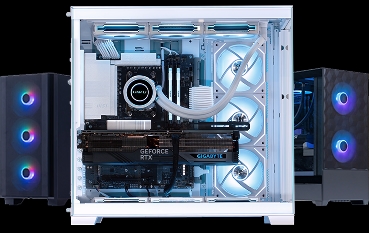
To support this work, Girmenia uses a custom-built Quoted One workstation named Tomato. The workstation combines a multicore processor, dedicated NVIDIA GPU, substantial system memory and fast NVMe storage to support Girmenia's image-processing and software-development workflow.
His research is conducted primarily through custom Python scripts, incorporating open-source astronomical packages such as Astropy. Girmenia initially used Tycho Tracker, an established asteroid-detection application, before developing software better suited to the characteristics of JWST observations.
Why the GPU matters
The shift-and-stack process is particularly well suited to GPU execution because candidate trajectories can be evaluated through parallel operations.
This represents a substantial improvement over Girmenia's previous computing environment. At the scale required for his research, the analysis was not practical without a dedicated GPU.
For Girmenia's highly parallel shift-and-stack workload, GPU acceleration makes an enormous difference. He estimates that an analysis requiring days of CPU-based processing could potentially be completed in minutes using a GPU, making computationally intensive searches practical on a local workstation.
Rather than reserving external computing resources for every experiment, Girmenia can develop, execute and refine computational methods directly on his workstation.
Eight Asteroids Discovered — and a Much Larger Dataset to Explore
Using Tomato, Girmenia developed and tested his image-processing pipeline against a small subset of publicly available JWST observations.
The pilot survey uncovered eight previously unidentified asteroids hidden within existing astronomical images.
The discoveries demonstrate the potential of applying new computational methods to data originally collected for entirely different scientific purposes. And the potential dataset is enormous.
The JWST archive contains many hundreds of terabytes of astronomical images. Girmenia hopes to expand his analysis across much of that archive, potentially identifying thousands of additional asteroids and other solar system objects.
What the detections can reveal
The observations can also provide estimates of an object's size and information about its composition.
Determining a reliable orbit is more challenging. JWST observations generally capture an asteroid for a relatively short period, often around an hour, whereas orbital determination typically requires observations spanning much longer intervals.
Nevertheless, individual detections can become valuable when linked with observations made at other times or by other instruments. Each newly identified object contributes another piece of information toward understanding small-asteroid populations.
Computing Freedom as a Research Advantage
Scientific research rarely follows a predictable path. Developing new algorithms often involves testing unconventional ideas, refining assumptions and exploring unexpected results.
For Girmenia, having powerful computing resources immediately available makes that experimentation easier. Unlike shared computing facilities, where jobs may involve queues and limited allocations, Tomato allows him to test and refine his methods whenever an idea emerges. That flexibility has been particularly valuable in developing his custom image-processing techniques.
“Having powerful computing resources available locally gives me a lot more freedom to experiment. Research doesn't always follow a predictable path, and sometimes you need to try unconventional approaches before finding something that works. With Tomato, I can develop and test new ideas without worrying about supercomputer queues or limited computing allocations. That flexibility has been a tremendous resource for my research.”
For researchers developing computationally intensive methods, that combination of performance, accessibility and reliability can be just as important as raw processing speed.
Expanding What Astronomical Data Can Reveal
Girmenia's research demonstrates how computational innovation can extend the scientific value of existing astronomical observations.
What began as images collected for other purposes has become an opportunity to identify previously undetected objects and improve our understanding of small-asteroid populations. As the research expands, it could also help resolve important uncertainties about the frequency of asteroid impacts on Earth.
For Quoted Tech, the project illustrates an important principle of scientific computing:
The right workstation doesn't simply make existing research faster. It can make entirely new approaches to discovery possible.